## The YouTube Sponsorship Doesn't End at the Sponsored Segment
When brands evaluate a sponsored YouTube video, most of the attention naturally goes to the integration itself.
Was the product presented correctly?
Did the creator communicate the key message?
Did the integration feel natural?
How many people watched it?
All important questions.
But there's another part of the video worth paying attention to:
the comments underneath it.
Because once the creator has delivered the message, the audience starts adding its own.
Comments Add Another Layer to the Sponsorship
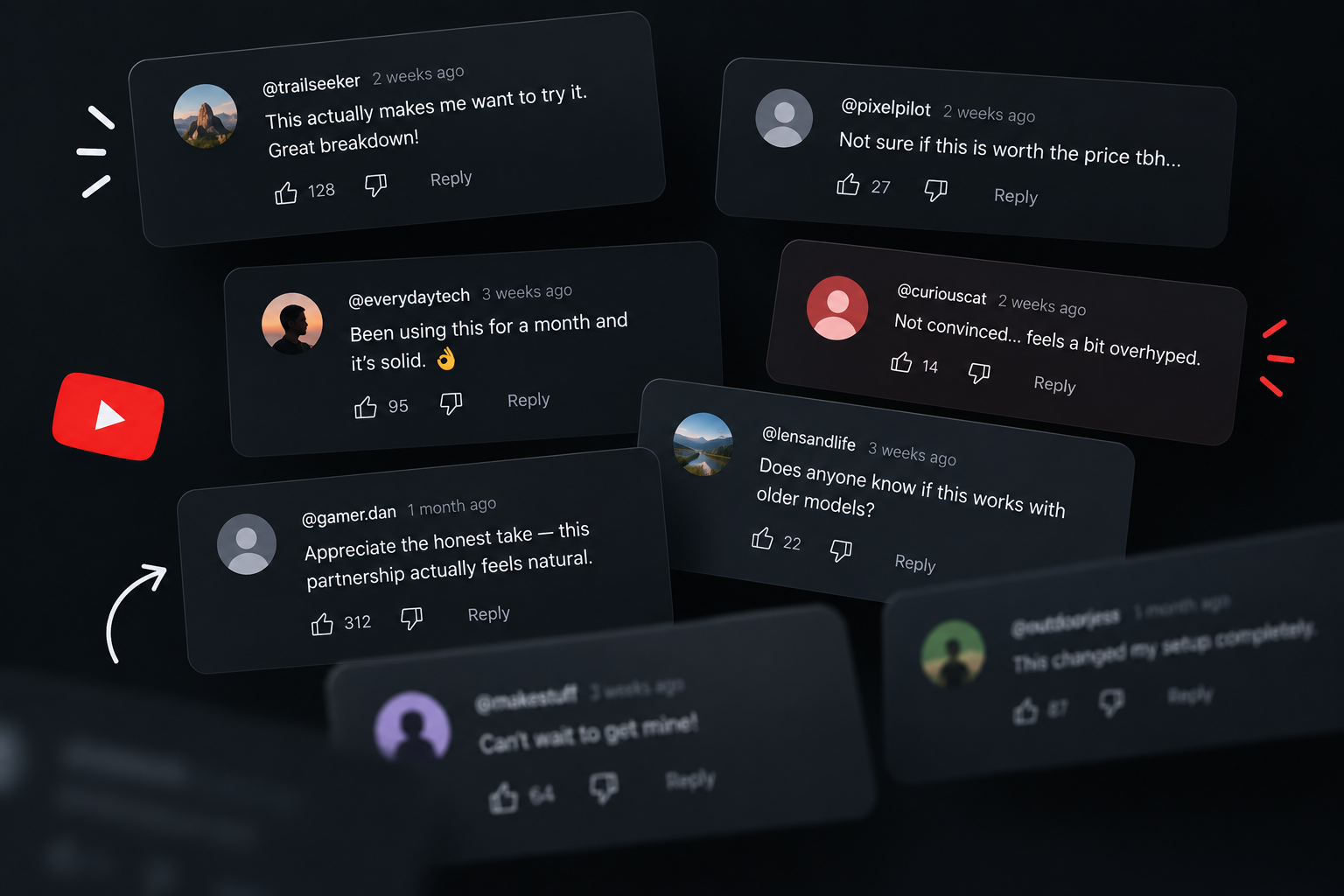
Scroll below almost any YouTube video and you'll see viewers discussing what they just watched.
Sponsored content is no different.
People might talk about the product, ask questions, share their own experiences, make jokes, defend the creator or criticize the partnership.
That conversation creates additional context around the sponsorship.
And research suggests it can matter.
A study examining YouTube influencer marketing found that comment sentiment can influence attitudes toward the promoted product as well as perceptions of the creator's trustworthiness.
In other words, viewers aren't necessarily interpreting a sponsorship in isolation.
What other viewers say can become part of that experience too.
Positive Comments Can Reinforce the Message
Imagine someone watches a creator introduce a product they've never heard of.
Then they open the comments and find viewers discussing their own positive experiences with it.
Those comments aren't part of the official campaign creative.
But they're sitting directly underneath it.
A positive discussion can provide additional context, answer questions and reinforce interest generated by the integration itself.
This doesn't mean brands should try to manufacture positive conversations.
It means organic audience response is another useful signal when evaluating how a sponsorship was received.
Negative Comments Matter Too
The opposite can happen.
Viewers might question whether the product fits the creator.
They might criticize the integration.
They might raise concerns about the product itself.
Ignoring that conversation means looking at only part of the audience response.
Interestingly, the research also found that when creators actively engaged with negative comments, some of their negative impact could be reduced.
That doesn't mean every critical comment needs a corporate response.
In fact, flooding a creator's comment section with brand replies could easily feel unnatural.
But legitimate questions, misunderstandings or concerns can sometimes benefit from a thoughtful response — particularly when the creator can answer in their normal voice.
What Should Brands Actually Look For?
Monitoring comments doesn't need to mean manually categorizing thousands of responses.
Start with a few simple questions:
→ Are viewers discussing the sponsored product at all?
→ Is the overall conversation positive, neutral or negative?
→ Are the same questions or objections appearing repeatedly?
→ Are viewers questioning the creator–brand fit?
→ Is the creator responding to product-related comments?
→ Are there insights the brand could use in future integrations?
The goal isn't simply to count positive and negative comments.
It's to understand how viewers are interpreting the partnership.
Comments Can Also Improve the Next Campaign
The comment section isn't only useful for evaluating what already happened.
It can help improve what happens next.
If dozens of viewers ask the same product question, perhaps the next integration should address it directly.
If viewers particularly like one feature the creator demonstrated, that may be worth emphasizing again.
If part of the sponsorship creates confusion, the next brief can be clearer.
That turns comments into more than an engagement metric.
They become qualitative campaign feedback directly from the audience you're trying to reach.
Look Below the Video
Views, clicks and conversions tell brands a lot about campaign performance.
But they don't capture everything.
Sometimes the clearest indication of how people actually received a sponsorship is sitting directly underneath the video.
The integration happens in the video.
The perception continues below it.
At TalentFuse, we help brands run YouTube creator campaigns with attention to more than just surface-level metrics — from creator selection and integrations to what happens after the video goes live.