# YouTube Sponsorships: When Is a Short Integration Better Than a Dedicated Video?
More screen time. More product information. More opportunities to convince viewers.
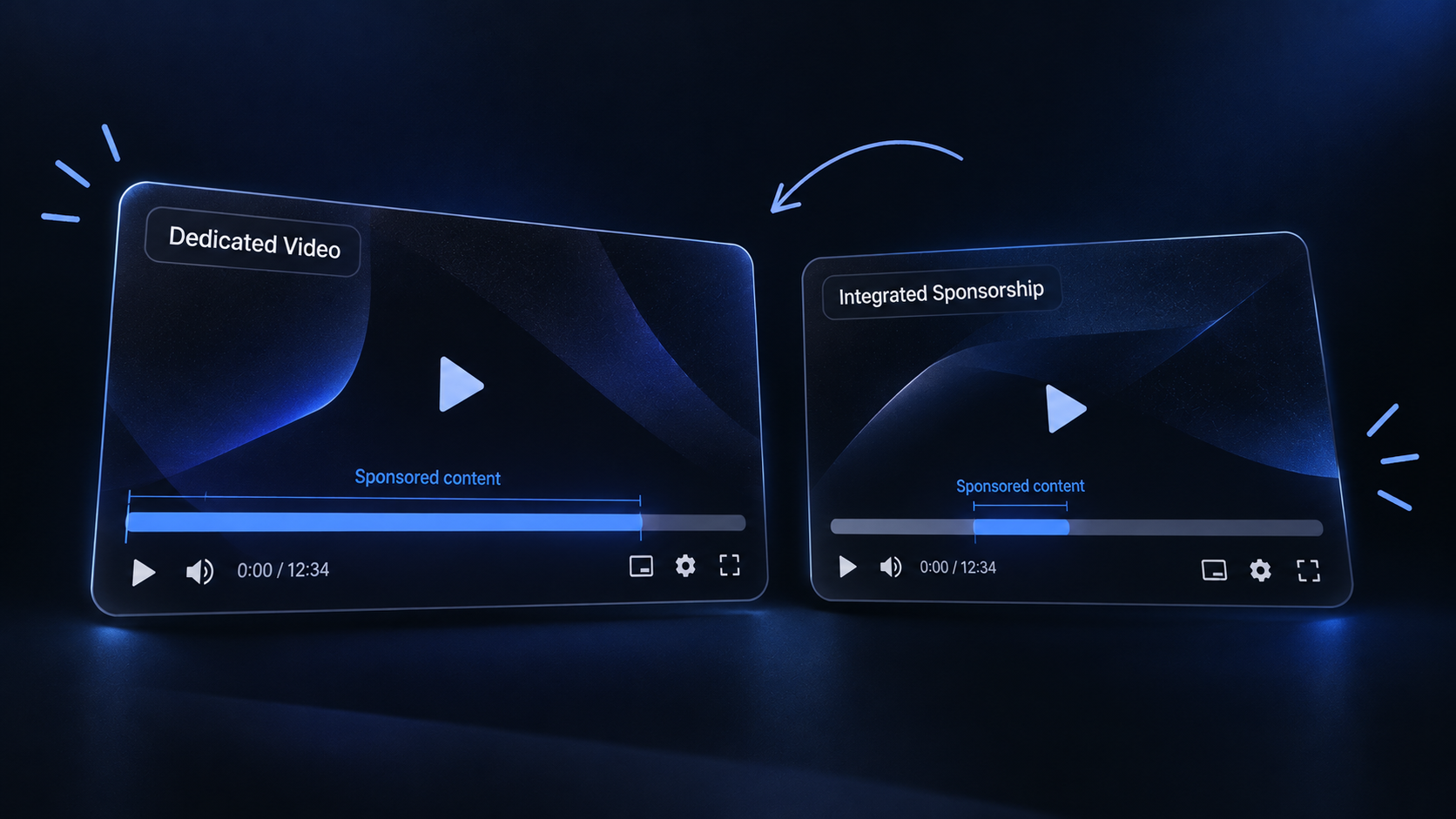
At first glance, a dedicated YouTube video might seem like the obvious choice for a brand.
But **more time spent promoting a product doesn't automatically mean a better campaign.**
Sometimes, a short integration within a creator's regular content can be just as relevant to the campaign's objectives — or even a smarter investment.
The question isn't how long your product appears on screen.
It's what that exposure actually achieves.
Does More Promotional Content Mean Better Engagement?
One concern with heavily sponsored content is that viewers don't necessarily come to YouTube to watch advertisements.
They come for the creator.
A study analyzing 598 sponsored influencer videos found that a higher proportion of promotional content was associated with lower audience engagement.
That's an important finding for brands planning YouTube sponsorships.
It suggests that giving a product more attention within a video isn't necessarily the best way to maintain audience engagement.
However, **this doesn't prove that shorter integrations always outperform dedicated videos.** Engagement is only one measure of campaign performance, and the study's finding is an association rather than proof that promotional length directly causes lower engagement.
The format still needs to match the product, the creator and the campaign's objectives.
When a Short YouTube Integration Makes Sense
Imagine a gaming creator publishing a video about their usual gameplay experience.
During the video, they naturally introduce a gaming accessory they're using.
They explain what it does, demonstrate a relevant feature and continue with the content viewers originally clicked to watch.
The sponsorship becomes part of the video rather than its entire purpose.
This approach can work particularly well when:
- **The product is easy to understand.** Viewers don't need a lengthy explanation to recognize its value.
- **The product fits the creator's content.** The integration feels relevant to what the audience is already watching.
- **The creator can demonstrate it naturally.** The product appears in a realistic context rather than an isolated promotional segment.
- **The campaign focuses on awareness or initial interest.** The goal is to introduce the product, not explain every detail.
A shorter integration can also allow a brand to distribute its budget across multiple creators rather than investing heavily in a single dedicated video.
Whether that approach is more effective depends on the creators, pricing and campaign goals.
When Is a Dedicated Video the Better Choice?
Shorter isn't always better.
Some products need more than a brief introduction.
Consider a new gaming monitor with several technical features, a complex software platform or a product that requires a detailed demonstration.
In those cases, a dedicated video can give the creator enough time to explain how the product works and why viewers might care.
A dedicated video may be worth considering when:
- The product requires an in-depth demonstration.
- Viewers are likely to research it before purchasing.
- The campaign aims to educate rather than simply introduce.
- The creator's audience actively watches reviews, tutorials or product comparisons.
A dedicated review from a relevant creator can provide a different kind of value than a brief mention during unrelated content.
The important thing is that the video gives viewers a genuine reason to watch.
**A dedicated video should be dedicated to delivering value, not just delivering advertising.**
The Creator's Content Should Influence the Format
One mistake brands can make is choosing the sponsorship format before considering how the creator normally communicates with their audience.
A creator known for detailed technology reviews may be well suited to a dedicated product video.
A gaming creator whose audience primarily watches entertaining gameplay might be better suited to a short, well-placed integration.
Neither format is automatically superior.
The difference is how naturally the sponsorship fits the content people expect from that channel.
That's why reviewing a creator's previous sponsored videos can be useful.
Pay attention to how products are introduced, whether integrations interrupt the viewing experience and how audiences respond.
The goal is to find a format that works with the creator's content rather than forcing the content to work around the advertisement.
How Should Brands Choose?
Before deciding between a dedicated video and an integration, ask four questions:
**1. How much explanation does the product need?**
If viewers can understand its value in 60 seconds, a full video may be unnecessary.
**2. What is the campaign trying to achieve?**
Awareness, product education and purchase consideration may call for different approaches.
**3. What content does the creator's audience expect?**
A sponsorship that fits the channel's usual format is generally a more natural starting point.
**4. What are you actually paying for?**
Compare the proposed deliverables, expected reach, audience relevance and pricing rather than assuming that more screen time automatically means more value.
These questions help brands choose based on campaign objectives instead of simply maximizing the amount of promotional content.
Make the Screen Time Count
A dedicated YouTube video can be a strong marketing asset.
So can a short integration within a creator's regular content.
The research on promotional content and engagement offers a useful reminder: **more advertising isn't necessarily better advertising.**
What matters is whether the product is presented in a way that makes sense for the creator, the audience and the campaign.
Before paying for more screen time, consider whether you actually need it.
Sometimes the most effective sponsorship isn't the longest one.
It's the one that fits.
At **TalentFuse**, we help brands find relevant YouTube creators and plan collaborations around their campaign objectives — from natural integrations to dedicated sponsored content.
**Planning your next YouTube campaign? Visit [talentfuse.eu](https://talentfuse.eu) and make your next creator campaign a better investment.**