How to Choose the Right Influencer for Your Brand
Choosing the right influencer is about much more than finding the creator with the biggest audience.
A creator can have hundreds of thousands of followers and still be a poor choice for your campaign. Another creator with a much smaller audience might be a far better match.
Why?
Because reach tells you how many people you could potentially reach. It doesn't tell you whether they are the right people.
And research supports this.
A major meta-analysis published in the Journal of the Academy of Marketing Science analyzed 1,531 effect sizes from 251 papers on influencer marketing.
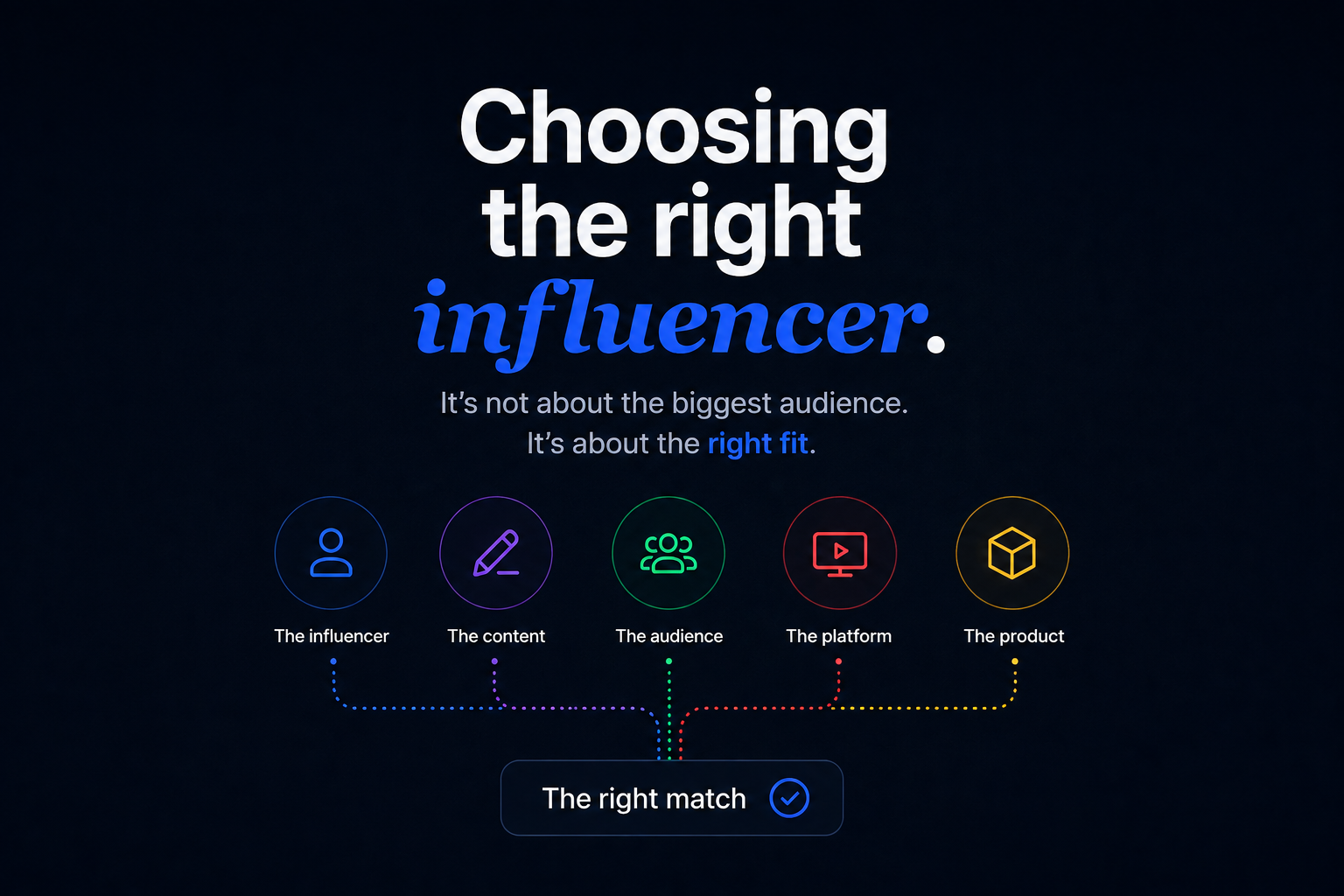
The research shows that influencer marketing effectiveness depends on multiple factors: including the influencer, content, audience, platform and product.
So how should brands actually choose influencers?
1. Start With Audience Fit, Not Follower Count
Imagine you're promoting a new gaming accessory.
Would you rather work with a general entertainment creator with 800,000 followers or a gaming creator with 150,000 followers whose audience closely matches your target customer?
The larger creator gives you more potential reach.
The second may give you something more valuable: relevance.
Before looking at the size of an influencer, brands should ask:
Who actually watches this creator? Where is their audience located? What is their audience interested in? Does that audience resemble our target customer? Why would this audience care about our product?
Follower count starts becoming meaningful only when the people behind that number are relevant to the campaign.
2. Look at Influencer–Brand Fit
There is also a difference between reaching the right demographic and choosing the right creator.
The partnership itself needs to make sense.
The meta-analysis found that influencer-brand fit can positively affect consumer responses.
This is easy to understand from the audience's perspective.
If a creator regularly talks about PC hardware, a gaming monitor sponsorship can feel like a natural extension of their usual content.
If the same creator suddenly promotes a completely unrelated product, the integration may feel much more like an advertisement.
A useful question for brands is therefore:
“Would this creator realistically talk about our product without a sponsorship?”
The closer the answer is to yes, the more natural the collaboration is likely to feel.
3. Don't Ignore Creator Credibility
Reach can get the message in front of people.
But the person delivering that message matters too.
The research indicates that source credibility plays an important role in consumer attitudes and engagement.
Brands should therefore look beyond surface-level metrics and understand how the creator communicates with their audience.
Do viewers trust their recommendations?
Does the creator appear knowledgeable within their niche?
Do people actually engage with what they say?
A creator isn't simply an advertising placement. Part of the value of influencer marketing comes from who is delivering the message.
4. Evaluate the Content, Platform and Product Together
There is no universally “best” influencer.
The right creator for one campaign may be completely wrong for another.
A successful match depends on the combination of:
Influencer × Content × Audience × Platform × Product
For example, a creator could have the right audience but produce a content format that makes your product difficult to demonstrate.
Or the creator and product could fit perfectly, while the platform isn't ideal for what the campaign needs to achieve.
This is why influencer selection shouldn't happen in isolation.
Brands need to consider the entire context of the campaign.
A Better Influencer Selection Checklist
Before choosing a creator, look beyond:
“How many followers do they have?”
Instead, ask:
**Audience:** Are we reaching the people we actually want to reach? **Brand fit:** Does this collaboration make sense for the creator? **Credibility:** Does their audience trust and engage with them? **Content:** Can our product fit naturally into what they create? **Platform:** Is this the right environment for our campaign? **Reach:** Once everything above fits, is the potential scale sufficient?
Follower count still matters.
The biggest influencer isn't automatically the best influencer.
Successful influencer selection is about finding creators where the audience, brand, content and campaign objective align.
That's the difference between buying reach and building a partnership that actually makes sense.
At TalentFuse, we help brands identify and connect with creators based on campaign fit.
** Source**:
Journal of the Academy of Marketing Science: meta-analysis of influencer marketing research covering 1,531 effect sizes from 251 papers.