Two YouTube Creators. Same Niche. Who Should Your Brand Choose?
Imagine you're planning a YouTube influencer campaign and your shortlist comes down to two creators.
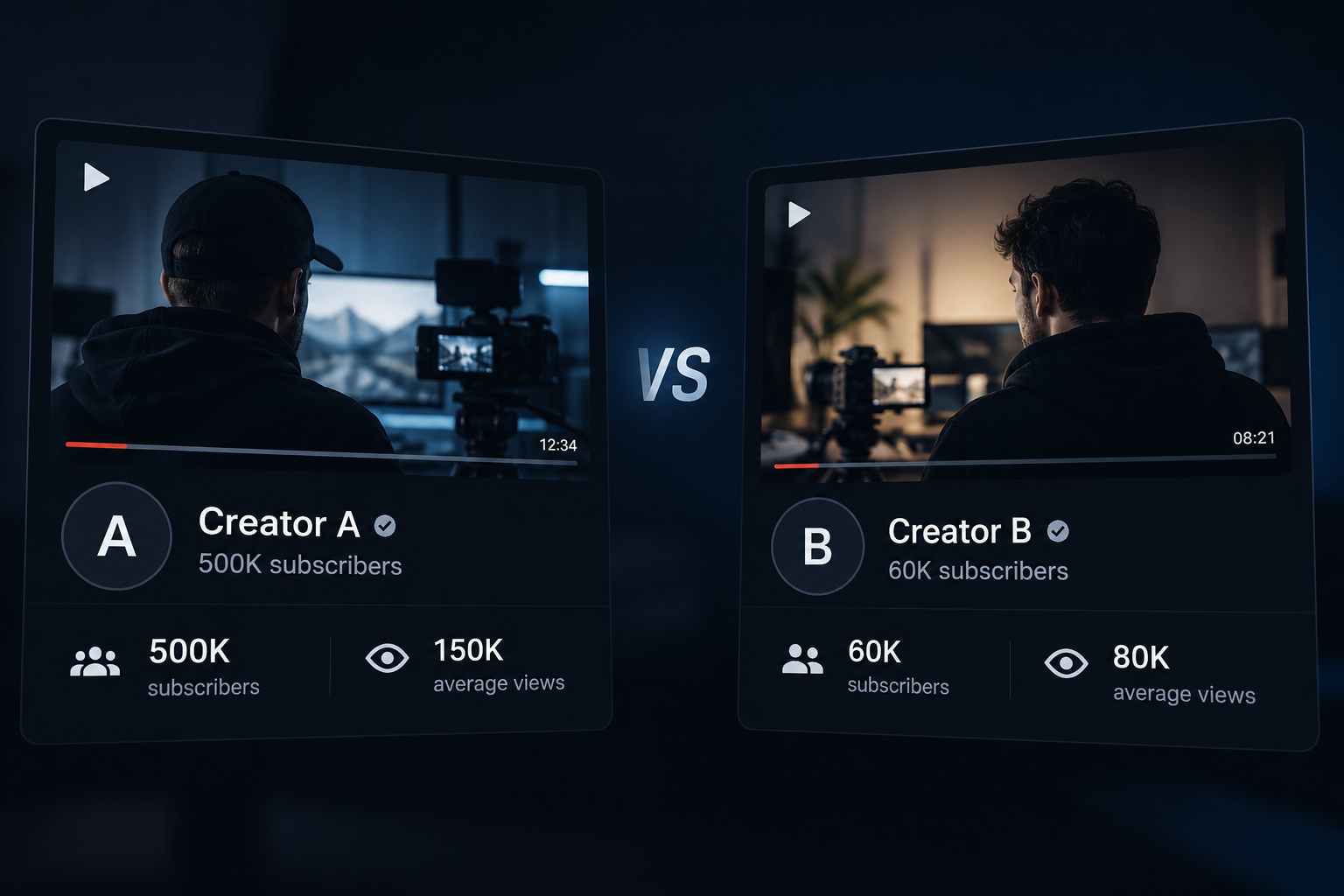
Creator A
500K subscribers 150K average views
Creator B
60K subscribers 80K average views
Who gets the campaign?
At first glance, Creator A seems like the obvious choice.
The channel is more than eight times larger and generates almost twice as many average views.
But those numbers don't answer the most important question:
Which creator is the better fit for this specific campaign?
That's where influencer selection gets more interesting.
Subscribers Tell You Size, Not Suitability
Subscriber count is useful context. But treating it as the deciding factor can oversimplify creator selection.
YouTube channels with very different subscriber counts can still generate meaningful viewership.
In our example, Creator B has only 12% as many subscribers as Creator A, yet generates more than half as many average views.
That alone doesn't make Creator B the better option.
But it should make you look deeper.
Instead of asking only:
“Which creator is bigger?"
Ask:
“What are we actually getting from each creator?”
1. Look at View Consistency
An average can hide a lot.
Two creators might both average 100K views, while their actual performance looks completely different.
One might consistently generate between 80K and 120K views.
Another might have several videos below 40K and one viral upload that pushes the average dramatically higher.
For a brand planning a campaign, those aren't necessarily the same proposition.
Look at recent uploads individually and ask:
How stable are the views? Are recent videos performing similarly to older ones? Are there major outliers affecting the average? What performance range appears realistic for a sponsored video?
You're not trying to predict an exact number of views.
You're trying to understand the creator's typical performance.
2. Understand Who Is Actually Watching
150K views from the wrong audience can be less valuable than 80K from the right one.
Suppose you're marketing a PC gaming accessory.
A creator reaching viewers interested in PC builds, gaming hardware and performance optimization may offer a more relevant audience than a much larger entertainment channel with broader demographics.
This is why audience relevance matters alongside reach.
Ask whether the creator's viewers align with:
your target market, relevant interests, target geography, the type of customer likely to buy your product.
More reach isn't automatically more valuable reach.
3. Check Whether the Product Belongs on the Channel
A sponsorship shouldn't feel like it was dropped randomly into a video.
Look at what the creator normally talks about.
Would your product make sense in that environment?
Could the creator demonstrate it naturally?
Would their viewers reasonably expect them to talk about a product like yours?
The stronger the connection between creator, content and product, the easier it is to build an integration that feels relevant rather than forced.
4. Review Previous Brand Integrations
One of the best ways to evaluate a potential partnership is to see how the creator has handled previous ones.
Don't just check whether they have worked with brands before.
Watch the integrations.
How was the product introduced?
Did the creator explain why it was relevant?
Was it incorporated into the content or simply read from a script?
How did viewers react?
Previous sponsorships can give you useful context about what your own integration could look like.
5. Put the Numbers in Context
Now we can return to our original comparison.
Creator A 500K subscribers 150K average views
Creator B 60K subscribers 80K average views
Based on these numbers alone, Creator A looks stronger.
But we're still missing:
→ Audience fit → View consistency → Product fit → Previous brand integrations → Campaign objectives
And suddenly the answer isn't so obvious.
Creator A could absolutely be the better choice.
But Creator B could be too.
We simply don't have enough information yet.
And that's the point.
Creator Selection Is a Business Decision
Choosing creators isn't a popularity contest.
Subscriber count and average views are useful starting points, but they shouldn't make the decision for you.
Brands should evaluate the bigger picture:
Performance. Audience. Content. Product fit. Previous integrations. Campaign goals.
Sometimes that analysis leads you to the biggest creator on the shortlist.
Sometimes it leads you to someone much smaller.
The goal isn't to find the creator with the most impressive number next to their name.
It's to find the creator who makes the most sense for the campaign.
At TalentFuse, we help brands identify and connect with YouTube creators based on campaign fit, not follower count alone.